


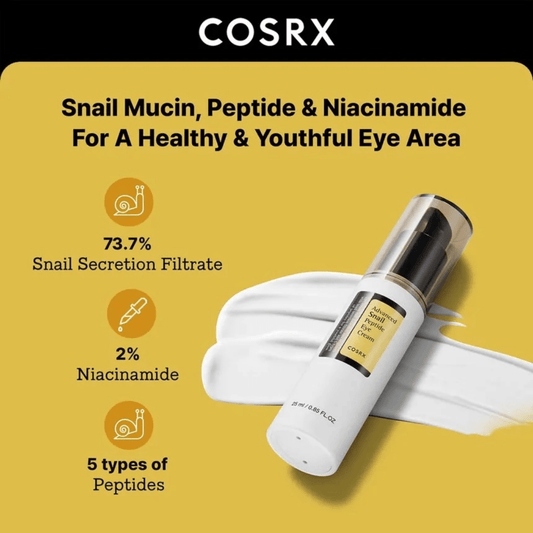

Korean Eye Creams for Wound-Healing focus on supporting the skin's natural recovery process when the orbital area is in a disrupted state. Whether the cause is a product reaction, blemishes near the eye, post-procedure sensitivity, or barrier damage from over-exfoliation, these formulas use ingredients that help skin move through its repair phases more comfortably and with less visible residue.
How the Skin Recovers Around the Eyes
Skin repair happens in overlapping phases: an initial inflammatory response, followed by a rebuilding phase where new tissue forms, and finally a remodelling phase where the surface smooths and strengthens. The orbital area is slower to repair than other parts of the face because it is thinner and less vascular. Supportive ingredients speed and calm each phase, centella stimulates collagen for the rebuilding stage; panthenol supports cell regeneration; allantoin promotes a smoother, healthier surface throughout.
- Centella stimulates collagen for rebuilding phase
- Panthenol supports cell regeneration and barrier
- Allantoin promotes a smoother recovered surface
- Thinner orbital skin needs extra recovery support
Ingredients That Support Skin Recovery
Beyond centella and panthenol, Korean wound-healing eye creams draw on snail mucin, which contains glycoproteins and growth factors that support skin renewal; zinc, which reduces inflammation; and ceramides, which restore the lipid structure that keeps the orbital skin protected. These are combined in fragrance-free, minimal formulas that add nothing to stress a recovering skin surface.
- Snail mucin glycoproteins support skin renewal
- Zinc reduces active inflammation around the eyes
- Ceramides restore the protective lipid barrier
- Fragrance-free minimal formulas avoid further stress
How to Use During Recovery
During active skin recovery around the eye area, simplify the entire routine. Use a gentle cleanser, apply a recovery-focused eye cream morning and evening, and use a basic moisturiser with no actives. Once the orbital skin feels stable, no stinging, no unusual dryness or flaking, reintroduce other products slowly, one at a time. The eye area may take two to four weeks longer to stabilise than the rest of the face.
- Simplify the routine during active recovery
- Morning and evening at the eye cream step
- Wait for skin stability before reintroducing actives
- Eye area may take longer than the rest of the face
After Recovery: Protecting What Was Rebuilt
Once the orbital area has recovered, the habits that caused the disruption are worth revisiting. Overuse of actives, harsh physical exfoliation near the eye, or using products not suited to the orbital area are common causes. Building in a regular check, once a month stepping back to assess whether the skin feels stable and comfortable, helps catch early signs of renewed barrier stress before it progresses. A recovery-ready eye cream kept in the routine as a once-weekly treatment also helps maintain resilience in the orbital area long-term.
- Review habits that caused the original disruption
- Monthly check on orbital skin comfort and stability
- Keep a recovery formula for early intervention use
- Preventing disruption is easier than recovering from it
Scroll up to explore the collection and find the Korean eye cream that supports your orbital skin through recovery with gentle, focused care.